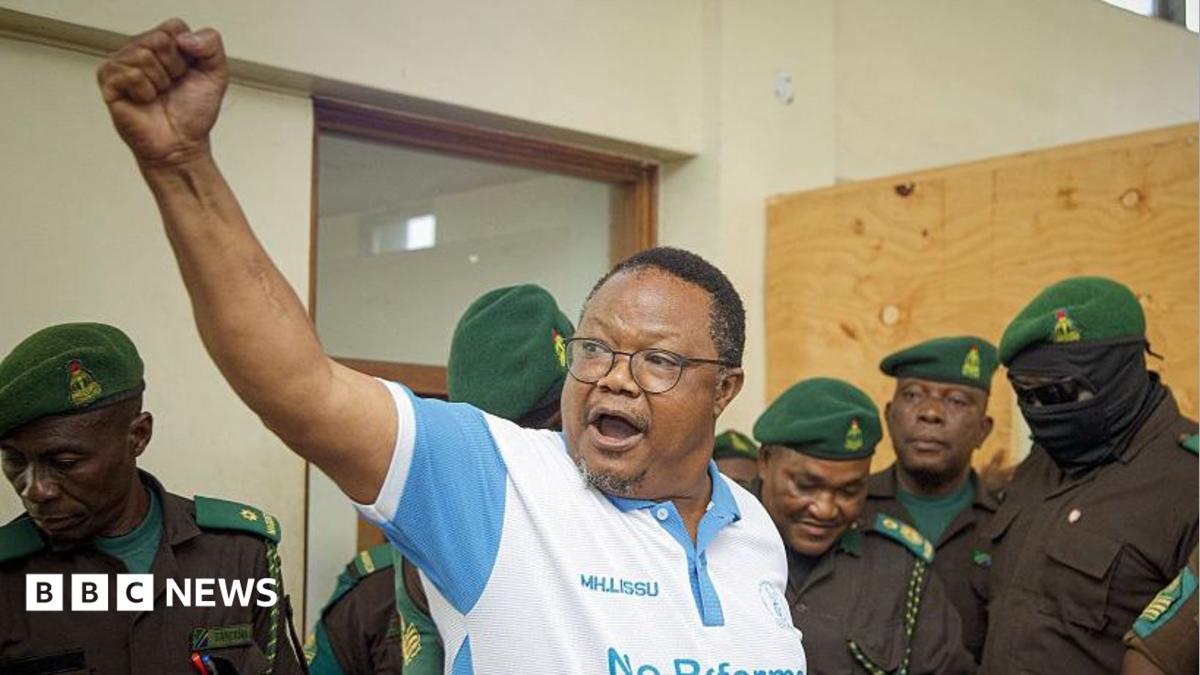
The Chadema chief was arrested six months earlier than the ballot, shortly after launching a marketing campaign demanding adjustments to the electoral system beneath the slogan “No Reforms, No Election”.
Prosecutors accused him of constructing statements supposed to incite the general public to disrupt the election and threaten the federal government.
They argued that his remarks, which had been additionally circulated on-line, amounted to treason.
However Lissu, a lawyer who represented himself in the course of the trial, maintained that his feedback had been a part of a authentic political marketing campaign for constitutional and electoral reform.
He argued that prosecutors had taken his statements out of context and didn’t show that he had dedicated any crime.
A number of the calls for raised by Chadema had been:
Electoral commissioners ought to be independently appointed (not by the president)
Police ought to enable all events to marketing campaign freed from intimidation
Authorities-appointed district chiefs ought to now not act as returning officers
Occasion brokers ought to have the ability to observe counting with out harassment
It ought to be potential to problem presidential election leads to court docket.
Throughout his time in remand custody at Dar es Salaam’s Ukonga Jail, Lissu went on starvation strike twice for temporary intervals when he mentioned he was not allowed entry to his attorneys or relations. He additionally complained that guards listened to what ought to have been personal consultations his attorneys.
These allegations have been denied by the jail authorities.
His case has attracted worldwide consideration, with rights teams expressing concern concerning the therapy of opposition politicians and the shrinking house for political dissent in Tanzania.
Final yr’s election was adopted by widespread protests and a violent safety crackdown that left at the very least 500 individuals lifeless, in accordance with an official inquiry.
Opposition teams have mentioned the loss of life toll was a lot increased and demanded an impartial investigation.
The federal government has defended its dealing with of the unrest and rejected accusations of widespread political repression.
Samia, 66, has insisted the election was honest and clear and blamed foreigners for the unrest, saying it was a part of a plot to overthrow her. She has arrange one other fee to inquiry to determine these behind the violence.
Lissu has lengthy been considered one of Tanzania’s most outspoken critics of the ruling Chama Cha Mapinduzi (CCM) occasion, which, together with its predecessor Tanu, has dominated the nation’s politics since independence.
He first turned an MP in 2010, representing a constituency close to his delivery place in Singida, 320km (200 miles) north-west of the capital, Dodoma.
In September 2017, the Chadema politician narrowly survived an assassination try when gunmen sprayed his car with bullets exterior his residence in Dodoma.
He was shot a number of instances and underwent in depth medical therapy overseas.
The assault, whose perpetrators have by no means been delivered to justice, pressured him to spend years exterior Tanzania.
He returned to contest the 2020 presidential election towards the late President John Magufuli, however misplaced in a vote that the opposition alleged was marred by widespread irregularities.
Lissu subsequently returned to exile earlier than coming again to Tanzania in 2023, following President Samia’s choice to carry a ban on opposition political rallies.
His return was initially seen as an indication of renewed political openness after years of restrictions beneath Magufuli, who died in workplace in 2021.
However relations between the federal government and the opposition deteriorated because the nation approached the 2025 election.
Lissu turned Chadema’s nationwide chairman in January 2025 and intensified his calls for for electoral reforms.
His conviction is prone to deepen considerations concerning the state of democracy in Tanzania.
Final week, rights group Amnesty Worldwide accused the federal government of constant its crackdown following the election and “weaponising counterterrorism legal guidelines to silence critics and instil concern”.
The authorities didn’t reply to a request for remark.